Most contractors know their contract value. Far fewer know how much cash the business has to put out before that contract pays anything back. A 13-week cash forecast for government contractors answers that question, and it is the most practical financial tool we know of for a year when federal timing may be less predictable.
What goes in a 13-week cash forecast
- Starting cash available today
- Expected receipts, entered in the week you realistically expect them
- Payroll runs on their real dates, including taxes and benefits
- Subcontractor and vendor payments on their required dates
- Fixed overhead and debt service
- Ending cash by week, rolled forward
Each of these is covered below, along with the carry period that sits underneath the whole forecast.
What is a carry period?
The carry period is the time between the first dollar the business spends on the work and the first dollar it receives for it. The carry amount is everything you pay out during that window: payroll and fringe, subcontractors, materials, insurance, software, and the share of overhead the contract absorbs.
Here is a hypothetical. A contract costs $85,000 a month to perform: $60,000 in payroll, $15,000 for a subcontractor, and $10,000 in allocated overhead. Work begins on the first of the month. Many service contracts are invoiced after the work is performed, on a schedule the contract sets, so the first invoice goes out after the month closes, and payment arrives some weeks after that. By the time the first payment lands, the business may have carried two months of costs or more, roughly $170,000.
That figure only means something when you compare it to the cash and available credit the business can actually use without putting payroll, taxes, or the rest of the company at risk. If the business has $120,000 it can comfortably use, the hypothetical contract above has a $50,000 gap before a single delay happens.
Build the 13-week cash forecast
A 13-week forecast lays out cash by week, which is how bills actually come due. Here is how to build one:
- Starting cash. Use the balance you actually have available today.
- Receipts by week. Enter expected payments in the week you realistically expect them. Use conservative timing, based on how long payments have actually taken, and leave out anything that has not been awarded or funded.
- Payroll. Enter each payroll run on its real date, including taxes and benefits.
- Subcontractors and vendors. Enter payments on the dates your agreements require.
- Fixed overhead and debt service. Rent, insurance, software, loan payments, and other recurring costs.
- Ending cash by week. Starting cash plus receipts minus payments, rolled forward each week.
Find the lowest week
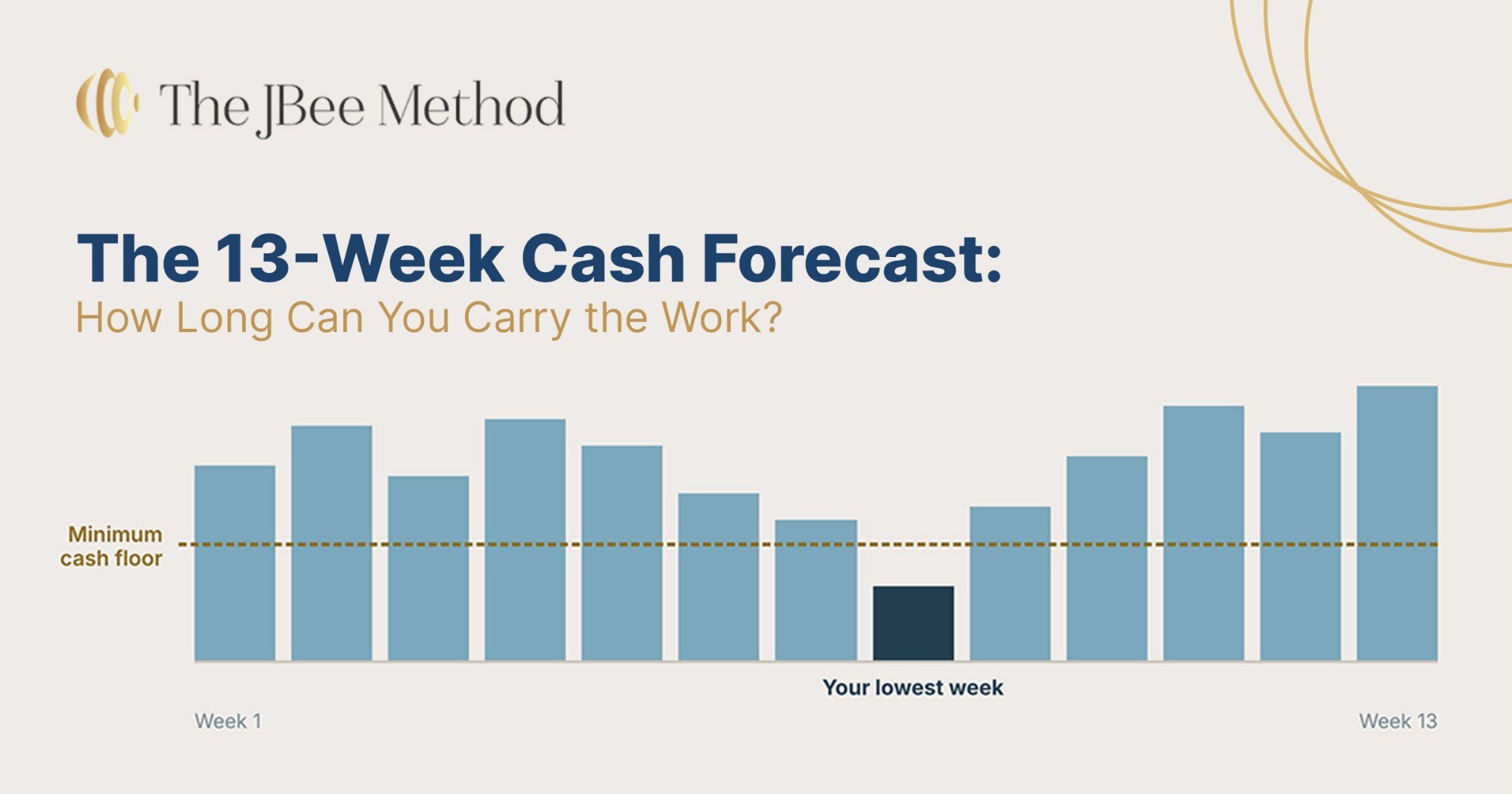
The most important number on the forecast is your lowest ending cash balance and the week it happens. It matters more than any monthly average, because payroll is due on a specific day. A month can look fine on average and still have one week where the account runs too low to cover a payroll run.
Once you can see that week, set a minimum cash floor, the balance you do not want to go below, and decide ahead of time what you would do if the forecast approaches it. That might mean drawing on a credit line, adjusting the timing of discretionary spending, or talking with a subcontractor about payment timing. Decisions like these are much easier to make with several weeks of notice.
Keep it current
A forecast is only useful if it is updated. Roll it forward every week, replace estimates with actual receipts and payments, and adjust expected payment dates based on what is actually happening. Once the structure is built, the weekly update should become a manageable routine.
Later this month we will show how to use the same forecast to test what happens if an award, option, or payment moves 30 or 60 days.
This article is general education and not legal or individualized financial advice. Dollar figures are hypothetical.

Know your numbers cold
Start with the free cash flow training, then book a GovCon financial readiness call.